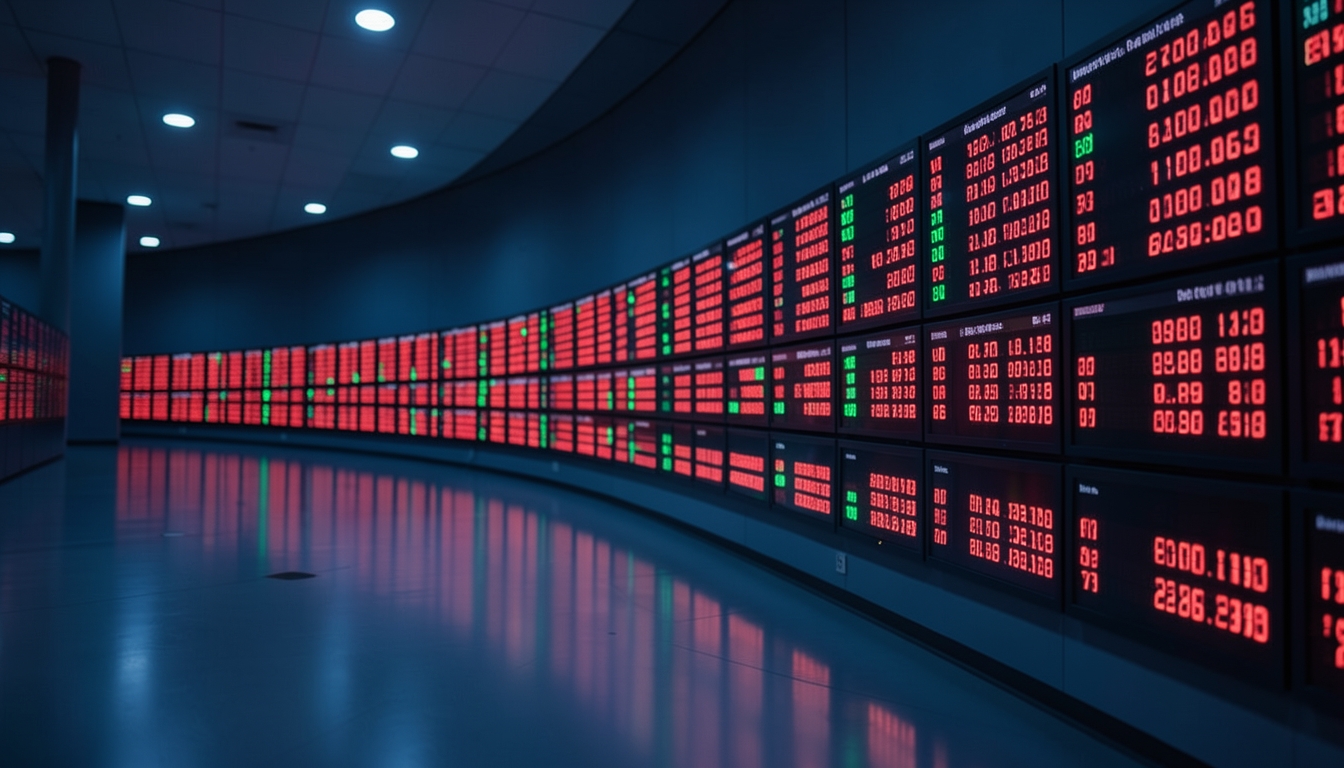
S&P 500 has its worst day since April 2025 as AI data-center stocks lead a broad sell-off
The Nasdaq composite fell 5.5% and the Dow 3.4% on Thursday, wiping out the post-election gain, as chipmakers and data-center suppliers fell most.
Add FinanceInTime as a preferred source on Google
The S&P 500 fell 4.4% to 7,353.73 on Thursday, November 5, its worst day since April 2025, and the Nasdaq composite fell 5.5% as stocks tied to AI data centers led the decline, according to The Associated Press. The drop came one day after the Dow's gain on the first session after the midterm elections.
Chipmakers took the largest losses
The Dow Jones Industrial Average fell 1,833.06 points, or 3.4%, to 51,523.06, and the Nasdaq composite fell 1,421.52 points, or 5.5%, to 24,315, the AP's closing table shows. The small-cap Russell 2000 index fell 4.4% to 2,729.89.
The BBC reported that Nvidia shares slid more than 9%, AMD and Micron each dropped by more than 17%, and the Philadelphia Semiconductor Index fell by more than 12%. It added that the so-called Magnificent Seven group of large technology companies shed a trillion dollars in market value in one session, and that the Nasdaq composite is now in correction territory, meaning at least 10% below its recent high.
The decline was not universal. Fortune reported that four of the S&P 500's 11 sectors rose on the day, including consumer staples, which gained 1.5%.
The session erased the post-election gain
On Wednesday, the Dow rose 1,569 points, or 3%, and the S&P 500 rose 1.6% to 7,688.62, Fortune reported; FinanceInTime covered that session. Measured against the S&P 500's close of 7,568.92 on Election Day, Tuesday, November 3, according to FRED data, Thursday's close was 215.19 points, or 2.8%, lower (computed).
The AP said the S&P 500 is down 3% for the week and up 7.4% for 2026.
What the reports tie the move to
Newsrooms linked the selling to the elections. The AP said investors worried about possible moratoriums on data centers after Democratic victories in the midterms. Al Jazeera, citing Reuters, reported that UBS analysts estimated construction pauses could put roughly 30% of planned US data center capacity additions in 2028 at risk, and that Wells Fargo estimates 27% of planned data center gigawatts are in Texas, Fortune said.
Michael Monaghan, a portfolio manager at Founders 100 ETF, told Al Jazeera that portfolio managers and analysts were "adjusting expectations for potential political resistance to AI infrastructure, particularly at the state and local levels." Susannah Streeter, chief investment strategist at Wealth Club, told the BBC that fears the money poured into AI infrastructure may not deliver the returns investors have been banking on were now colliding with the prospect of a sharp slowdown in data center construction.
The data do not show how much of Thursday's move came from the election, how much from earlier worries about AI spending, and how much from company earnings news, such as the weaker technology earnings Fortune cited.
We would read this as a repricing of one theme, not of the whole market
We think Thursday says more about how concentrated the market's gains had become than about the election itself. The S&P 500 is still up 7.4% for 2026, and four sectors rose on a day the index fell 4.4%, so the loss sits in a narrow group of stocks that had carried the year.
The opportunity is that a move this concentrated can broaden gains beyond a few large stocks if money rotates toward the sectors that held up. The threat is that a state-level pause on data center construction lowers the spending that the chip and equipment makers depend on. We expect weeks of volatility in AI-linked shares if more states move toward pauses, and a calmer market if the pauses prove narrower than the early estimates. We would change our view if the rest of the market starts to fall alongside the chipmakers, which would point to a wider repricing of rates or earnings.
The view in this final section is FinanceInTime's editorial opinion, for information only. It is not investment, tax, legal or other advice, and it does not take your circumstances into account. Forecasts are uncertain and past results do not guarantee future ones.
Sources
- How major US stock indexes fared Thursday 11/5/2026 — The Associated Press (via WTOP)Secondary source
- Major tech stocks plunge as US midterms add to fears of AI slowdown — BBC NewsSecondary source
- Wall Street's best post-midterm rally in 44 years lasted just one day — FortuneSecondary source
- AI stocks plunge after US election, driving down markets — Al JazeeraSecondary source
- S&P 500 (SP500) — FRED, S&P Dow Jones IndicesData
More in Markets
View All Markets